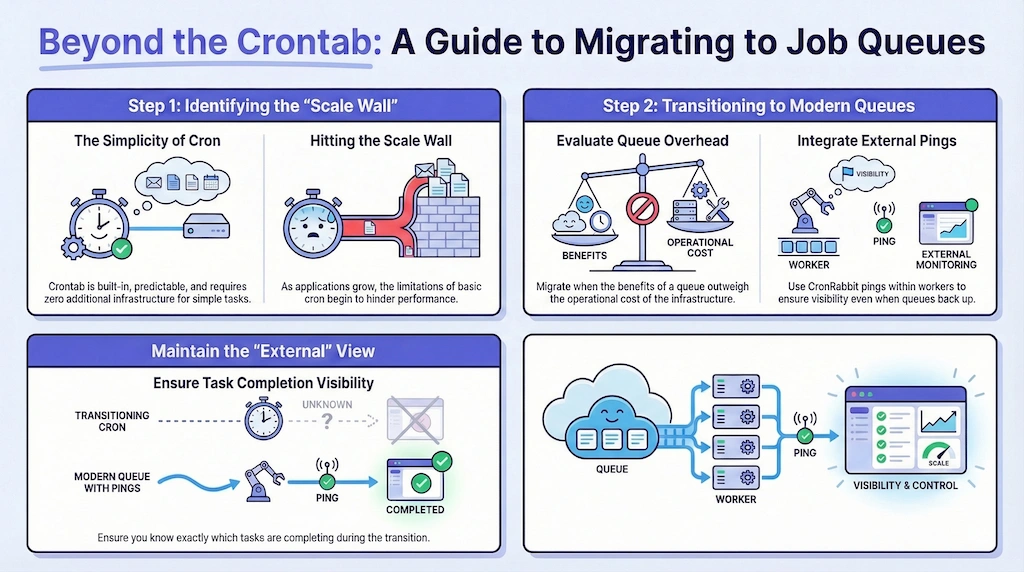

The simplicity of crontab -e is hard to beat. It’s built-in, predictable, and requires zero extra infrastructure. But as your application grows, you eventually hit the "Scale Wall."
In this article, we’ll explore when it’s time to move beyond simple cron and how to maintain visibility during the transition.
The "Scale Wall"
You know you've hit the wall when:
- Concurrent Execution: You need two jobs to run at once, but they overlap and lock the database.
- Retry Logic: A network blip kills a job, and you have no automated way to retry it with exponential backoff.
- Complex Dependencies: Job B should only run if Job A succeeds. Managing this in shell scripts is a nightmare.
Introducing Modern Queues
When the overhead of a queue becomes worth it:
- Celery (Python)
- BullMQ (Node.js)
- Sidekiq (Ruby)
- Asynq (Go)
Maintaining Visibility
The danger of migrating to a queue is losing the "external" view of your jobs. CronRabbit pings should be integrated into your workers to ensure that even if the queue is backing up, you know exactly which tasks are still completing.
Visualizing the Difference